
Classic Beef Chili Con Carne
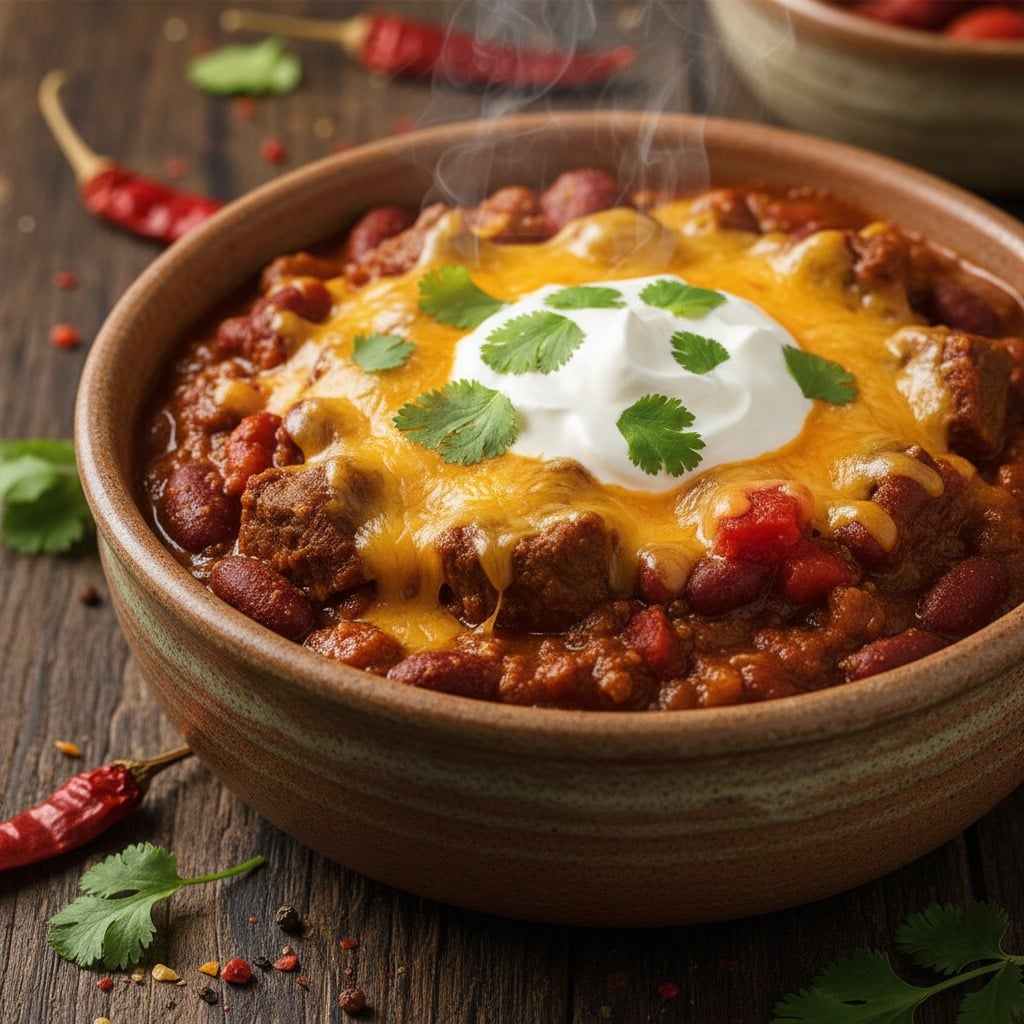
Overview
- Prep Time: 15 minutes
- Cook Time: 45 minutes
- Servings: 6
- Difficulty: Easy
Ingredients
- 1 tablespoon olive oil or vegetable oil
- 2 lbs lean ground beef (85/15)
- 1 large yellow onion, diced
- 1 medium red or green bell pepper, diced
- 4 cloves garlic, minced
- 1 jalapeño pepper, seeded and finely diced (optional, for extra heat)
- 2 tablespoons tomato paste
- 2 tablespoons chili powder
- 2 teaspoons ground cumin
- 1 teaspoon smoked paprika
- 1 teaspoon dried oregano
- 1/2 teaspoon cayenne pepper (adjust to spice preference)
- 1 teaspoon kosher salt (plus more to taste)
- 1/2 teaspoon freshly ground black pepper
- 1 (28-oz) can crushed tomatoes (or diced tomatoes)
- 1 and 1/2 cups beef broth
- 2 (15-oz) cans dark red kidney beans, drained and rinsed
Instructions
- Sauté the vegetables. Heat the oil in a large Dutch oven or heavy-bottomed pot over medium-high heat. Add the diced onion, bell pepper, and jalapeño, cooking for 5 to 6 minutes until softened.
- Brown the beef. Add the ground beef to the pot, breaking it apart with a wooden spoon. Cook for 7 to 8 minutes until the meat is browned and no longer pink, then carefully drain any excess grease.
- Bloom the spices and tomato paste. Stir in the minced garlic, tomato paste, chili powder, cumin, smoked paprika, oregano, cayenne pepper, salt, and black pepper. Cook for 1 to 2 minutes, stirring constantly, until the spices are deeply fragrant and the tomato paste darkens slightly.
- Simmer the chili. Pour in the crushed tomatoes, beef broth, and rinsed kidney beans, stirring well to combine. Bring the mixture to a gentle boil, then reduce the heat to low.
- Thicken and develop flavor. Simmer uncovered for 30 to 35 minutes, stirring occasionally so the bottom does not stick, until the chili thickens to your desired consistency.
- Taste and serve. Taste the chili and adjust the salt or cayenne pepper if needed. Ladle into bowls and serve hot with your favorite toppings.
Cultural History
The Origins and Evolution of Chili con Carne: A Cultural History
Few dishes evoke as much passionate debate, regional pride, and culinary mythology as chili con carne. To trace the history of chili is to journey through the crossroads of Indigenous American traditions, Spanish colonial expansion, Mexican ingenuity, and Anglo-American frontier expansion. Far more than a simple stew of meat and peppers, chili con carne is a cultural artifact that mirrors the complex history of the American Southwest and Northern Mexico.
The Indigenous Foundations
While the modern conception of chili con carne does not trace back in a direct line to pre-Columbian times, its fundamental ingredients are deeply rooted in the ancient foodways of the Americas. Indigenous peoples of Mesoamerica and the American Southwest cultivated and consumed chili peppers and wild game long before European contact.
The chili pepper (Capsicum annuum) was domesticated in Mesoamerica thousands of years ago and spread rapidly across the Americas, becoming a staple in both diet and medicine. In the region that would become the borderlands of Texas and Mexico, indigenous populations utilized wild peppers, venison, and local herbs. When Spanish explorers and settlers arrived in the 16th and 17th centuries, they encountered a palate already accustomed to intense heat and spiced flavors. The culinary collision of European livestock—specifically beef, pork, and spices brought by the Spanish—with native New World peppers laid the foundational palette for what would eventually evolve into chili.
The San Antonio Chili Queens and the 19th-Century Birth of Chili
The true genesis of chili con carne as a distinct dish is most reliably traced to 19th-century San Antonio, Texas. By the mid-1800s, San Antonio was a vibrant cultural melting pot where Tejano, Mexican, and Anglo-American traditions intersected.
It was in the bustling plazas of San Antonio, particularly Military Plaza and Main Plaza, that the legendary “Chili Queens” made their mark. These enterprising women, largely of Mexican descent, set up open-air food stalls at dusk, transforming the public squares into bustling communal dining rooms. They served steaming bowls of food to travelers, soldiers, cattle drovers, and locals alike.
The dish served by the Chili Queens was typically made from beef, which was often hand-cut rather than ground, simmered in a rich, thick sauce heavily spiced with cumin, garlic, onions, and dried chili peppers—most notably ancho and pasilla varieties. Crucially, early San Antonio chili did not contain beans or tomatoes. Beans were viewed by many traditionalists as a cheap filler, and tomatoes were historically considered an unnecessary addition to a dish whose flavor profile was meant to be dominated by the earthiness of the peppers.
The Chili Queens became a fixture of Texas folklore and tourism. Visitors to San Antonio frequently wrote about the intoxicating aromas of the plazas and the savory, fiery kick of the chili. This street food culture effectively baptized chili con carne as a uniquely Texan creation, even as it drew heavily from Mexican culinary roots.
The Spread: From Frontier Outposts to the World Stage
As the Texas cattle industry boomed in the late 19th century, cowboys and trail drivers helped carry chili beyond the borders of San Antonio. On long cattle drives across the open range, chuckwagon cooks found that chili was a practical, durable meal. Dried chili peppers, onions, garlic, and salted or dried beef could easily be packed and preserved. Furthermore, grinding or chopping tough cuts of beef and simmering them for hours rendered the meat tender, while the heavy spices masked the gamey or preserved flavors of the protein.
Chili’s national exposure skyrocketed at the turn of the 20th century, largely thanks to the 1893 Columbian Exposition in Chicago. The San Antonio chili stand at the world’s fair introduced millions of Americans to the dish, capturing the national imagination. Following this success, entrepreneurs began commercializing the recipe. In the 1890s, companies like Gebhardt’s Eagle Chili Powder hit the market, blending ground anchos, cumin, garlic, and oregano into a convenient, shelf-stable powder. This invention democratized chili-making, allowing households far outside of Texas to replicate the flavor profile of Southwestern chili without having to source and grind dried pods themselves.
Throughout the early 20th century, “chili parlors” proliferated across the United States. During the Great Depression, chili’s affordability and high caloric content made it a lifeline for working-class Americans. Often sold cheaply out of diners, lunch counters, and dedicated chili joints, the dish became an accessible comfort food. In places like Cincinnati, Ohio, Greek immigrants adapted the dish by adding Mediterranean spices like cinnamon, allspice, and cloves, serving it over spaghetti with a mountain of cheddar cheese—creating the distinct regional variation known as Cincinnati chili.
The Chili Wars and Cultural Identity
As chili con carne grew in popularity across the United States, it also sparked intense debates regarding authenticity, which culminated in the “Chili Wars” of the mid-to-late 20th century.
Texans developed an almost religious fervor regarding what constituted “real” chili. This regional protectionism was immortalized by humorist H. Allen Smith in a famous 1967 article for Holiday magazine, which ignited a legendary chili cook-off duel between Smith and writer Wick Fowler. This event birthed the Terlingua International Chili Championship, held annually in a remote ghost town in West Texas.
The strict rules of traditional Texas chili competitions codified a dogma that persists to this day: “If you use beans, you’re eating bean soup.” Purists argued that beans, macaroni, and rice diluted the pure essence of the meat and chili paste. This stance often brought Texans into conflict with the rest of the country, where adding beans or tomatoes was standard practice.
Despite—or perhaps because of—these regional divides, chili con carne was officially designated the state dish of Texas in 1977. Lawmakers recognized that chili was not merely food, but a profound cultural symbol representing the rugged individualism, resourcefulness, and multicultural heritage of the state.
Chili in the Modern Era
Today, chili con carne occupies a fascinating space in global gastronomy. It is a chameleon of a dish, adapting seamlessly to modern dietary trends and global palates. While traditional beef-and-chili-paste stews remain beloved, the contemporary culinary landscape embraces countless variations: white chili made with chicken and white beans, vegetarian and vegan adaptations utilizing lentils, sweet potatoes, and black beans, and fusion variations incorporating ingredients like chipotle, cocoa powder, and craft beer.
Yet, despite these modern evolutions, the cultural resonance of chili con carne remains anchored in its history. It is a dish born of necessity, ingenuity, and cultural synthesis. It reflects the blending of Spanish, Mexican, and American influences on the frontier, preserved through the labor of the San Antonio Chili Queens and romanticized by generations of cowboys and writers. Whether served out of a cast-iron pot at a Texas campsite, ladled over spaghetti in an Ohio diner, or simmered in a home kitchen on a cold autumn evening, chili con carne remains a powerful culinary tradition—a humble, fiery stew that tells the story of the American Southwest.
-

Classic Moist Chocolate Layer Cake
Classic Moist Chocolate Layer Cake Classic Moist Chocolate Layer Cake Overview Ingredients For the Chocolate…
-
Classic Creamy Alfredo Sauce
Classic Creamy Alfredo Sauce Overview Ingredients Instructions Cultural History The Story Behind Alfredo Sauce: From…
-
Classic Beef Chili Con Carne
Classic Beef Chili Con Carne Overview Ingredients Instructions Cultural History The Origins and Evolution of…

Leave a Reply