
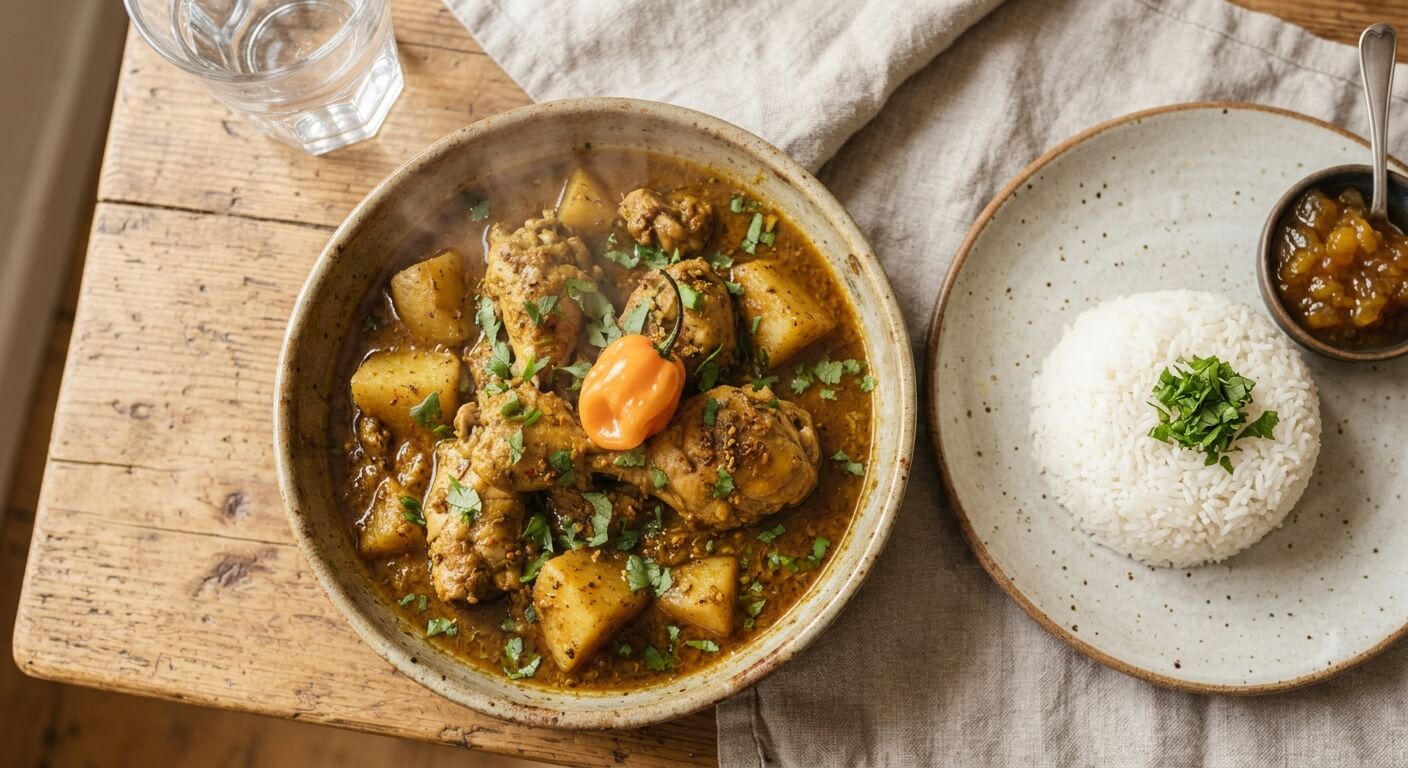
Curry Chicken Trinidadian style
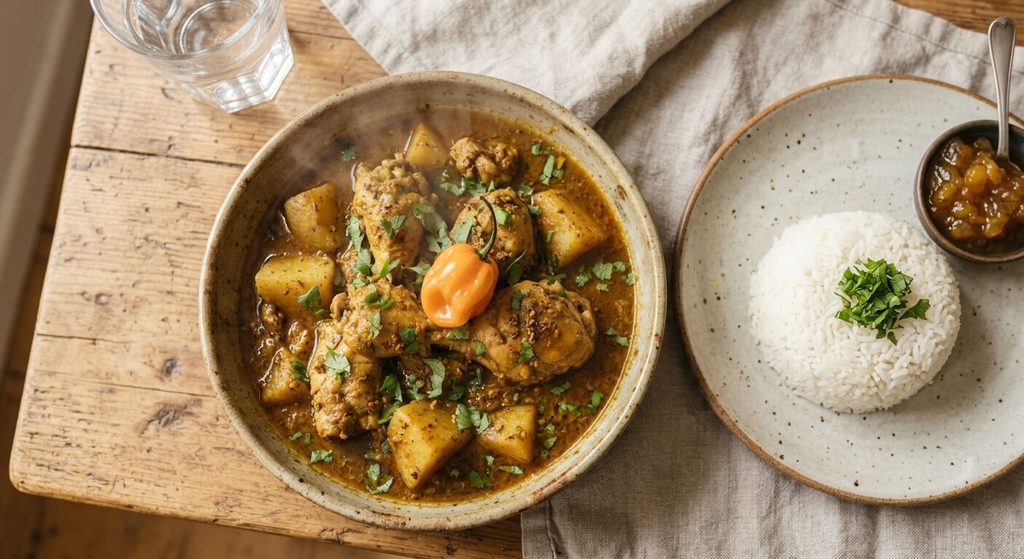
Overview
- Prep Time: 20 minutes (plus at least 1 hour marinating)
- Cook Time: 40 minutes
- Servings: 6
- Difficulty: Medium
Ingredients
- 3 lbs bone-in, skinless chicken pieces (cut into bite-sized curry pieces, washed with lime or lemon juice and water)
- 3 tablespoons Trinidadian green seasoning (a blend of culantro/chadon beni, scallions, garlic, thyme, and pimento peppers)
- 3 tablespoons Caribbean curry powder (divided: 1 tablespoon for marinating, 2 tablespoons for cooking)
- 1 teaspoon roasted geera (ground roasted cumin)
- 4 cloves garlic, minced
- 1 medium yellow onion, diced
- 1 whole scotch bonnet or habanero pepper (keep whole for aroma without extreme heat, or chop to taste)
- 2 medium russet or Yukon Gold potatoes, peeled and cut into large chunks
- 2 tablespoons vegetable or canola oil
- 1.5 cups hot water or chicken broth
- 1.5 teaspoons salt (plus more to taste)
- 1/2 teaspoon freshly cracked black pepper
Instructions
- Marinate the chicken. Place the cleaned chicken pieces in a large bowl. Add the green seasoning, 1 tablespoon of curry powder, half of the minced garlic, salt, and black pepper. Mix well to coat every piece, cover, and marinate in the refrigerator for at least 1 hour or overnight.
- Make the curry paste. In a small bowl, mix the remaining 2 tablespoons of curry powder and the roasted geera with 3 to 4 tablespoons of water to form a thick, smooth paste. Creating a paste keeps the spices from burning in the hot oil.
- Bloom the curry. Heat the oil in a heavy-bottomed pot or Dutch oven over medium-high heat. Add the diced onion and remaining garlic, cooking for 2 minutes until fragrant. Pour in the curry paste and stir constantly for 2 to 3 minutes until the liquid evaporates, the curry darkens slightly, and the mixture becomes grainy and aromatic.
- Sear the chicken. Add the marinated chicken to the pot, stirring vigorously to coat each piece in the cooked curry paste. Cook uncovered over medium-high heat for 8 to 10 minutes, stirring occasionally, until the chicken releases its natural juices and begins to sear.
- Simmer with potatoes. Add the potato chunks and the whole scotch bonnet pepper to the pot, stirring gently so you do not burst the pepper. Pour in the hot water or broth until it just barely covers the chicken.
- Cook until tender. Cover the pot, reduce the heat to medium-low, and simmer for 20 to 25 minutes until the chicken is tender and the potatoes are cooked through. If you want a thicker gravy, mash two or three pieces of the cooked potato against the side of the pot and stir them into the sauce.
- Finish and serve. Taste the gravy and adjust the salt if needed. Remove the whole scotch bonnet pepper before serving.
Cultural History
The aromatic trail of Trinidadian curry chicken is a sensory map that traces centuries of global migration, colonial exploitation, cultural adaptation, and the ultimate creation of a distinct Caribbean identity. To understand this iconic dish is to understand the soul of Trinidad and Tobago, a nation where the convergence of indigenous, African, European, and South Asian influences has birthed one of the world’s most dynamic culinary traditions. Curry chicken in Trinidad is not merely a meal; it is a historical archive simmered in pot, a testament to resilience, and a centerpiece of daily life and grand celebrations alike.
The foundational narrative of Trinidadian curry begins long before the first curry powder touched a local pot. Before European contact, the island was inhabited by indigenous peoples, notably the Arawaks and Caribs, who utilized local flora, an array of peppers, and techniques of smoking and roasting to flavor their food. However, the dramatic transformation of the island’s culinary landscape started with the arrival of Spanish colonizers, followed by the French and the British. The establishment of sugar and cocoa plantations created an insatiable demand for labor. Initially, this was met through the brutal trans-Atlantic slave trade, forcibly bringing millions of West Africans to the shores of the Caribbean.
African culinary traditions heavily shaped the foundational techniques of Trinidadian cooking. Enslaved Africans adapted their traditional methods of stewing, the use of local root vegetables, and the incorporation of fresh herbs and peppers to available ingredients. They introduced the concept of “seasoning” meat thoroughly before cooking and developing complex flavor bases, laying the groundwork for what would eventually become the Trinidadian style of pot management.
The definitive chapter in the history of Trinidadian curry opened in 1845, with the arrival of the Fatel Razack, the first ship carrying indentured laborers from India to Trinidad. Following the abolition of slavery in the British Empire in 1834, plantation owners faced a severe labor shortage. To keep the sugar economy afloat, the British colonial government instituted a system of Indian indenture. Between 1845 and 1917, over 140,000 Indian laborers, predominantly from the regions of Uttar Pradesh, Bihar, and parts of South India, arrived on the island.
These immigrants brought with them their culture, religion, music, and, most importantly, their food. They carried spices in their luggage and hearts: turmeric, cumin, coriander, fenugreek, mustard seeds, and black pepper. In their new home, they attempted to recreate the flavors of the subcontinent using the spices they had brought and whatever local ingredients were available.
However, authentic Indian cooking relies heavily on the art of masala—the individual roasting, grinding, and blending of whole spices for specific dishes. The grueling conditions of plantation labor, combined with the lack of specialized grinding stones (sil and batta) in the initial period of indenture, forced a practical evolution. Indian laborers began to pre-blend their spices into a convenient powder, mirroring the British taste for curry powder that had developed during the colonial Raj. This pre-blended powder, often heavily featuring turmeric for that vibrant yellow hue, became the birth of Caribbean curry powder.
As the indentured laborers settled, interaction between the diverse ethnic groups on the island intensified. Trinidad was a melting pot of necessity. Afro-Trinidadians and Indo-Trinidadians lived, worked, and suffered side-by-side under the heavy hand of the colonial plantation system. Over decades, cultural exchange flourished, crossing racial and social divides.
Food was the ultimate bridge. Afro-Trinidadians adopted the use of curry powder, infusing it with their own established culinary grammar. While an indentured laborer might have cooked a traditional, vegetable-heavy or thinly-sauced curry, the Afro-Trinidadian adaptation incorporated the heavy seasoning of meats with green seasoning—a vibrant blend of chadon beni (cilantro’s pungent Caribbean cousin), garlic, onions, thyme, scallions, and hot peppers—and a unique browning technique.
This brings us to the signature process of making Trinidadian curry chicken: burning the curry. Unlike in many traditional Indian styles where spices are bloomed in hot oil or ghee (known as tadka or baghar), the Trinidadian method often involves mixing the curry powder with a little water to form a paste, then adding it to a pot of hot oil in which a small amount of sugar has been allowed to caramelize, or simply burning the dry powder directly in the oil until it darkens and becomes fragrant. This “burning” of the curry is a critical step that removes the raw, chalky taste of the turmeric and releases deep, earthy, slightly smoky flavor notes.
Once the curry paste is properly fried, the seasoned chicken—marinated for hours or even days in green seasoning, salt, pepper, and sometimes ginger and garlic—is added to the pot. The chicken is turned frequently, allowing it to absorb the spiced oil and sear, a process known as “browning down” or “cook up.” Water is then added to create a rich, savory gravy, and the pot is covered to let the chicken tenderize. Potatoes, and occasionally chickpeas (channa) or mango, are frequently added to the pot, stretching the meal and adding comforting textures that absorb the spiced gravy.
By the mid-20th century, curry chicken had transitioned from a localized ethnic dish to a national symbol. As Trinidad and Tobago moved toward independence in 1962, a distinct national identity began to solidify, heavily rooted in its multicultural heritage. Curry chicken was no longer just Indian or Afro-Trinidadian; it was simply Trinidadian. It became the undisputed star of Sunday lunch, a weekly ritual in many Trinidadian households where families gather to partake in a feast of rice, dhal, stewed or curried meats, macaroni pie, and fried plantains.
Furthermore, curry chicken found an immortalized partner in the national street food: the roti. The roti—specifically variations like dhalpuri (stuffed with ground yellow split peas) and paratha (commonly known as “bust-up-shut” due to its shredded, flaky appearance)—became the perfect vessel for curry chicken. Eating a messy, delicious chicken roti wrap or breaking apart a paratha to scoop up tender pieces of curried chicken and potatoes became a quintessential Trinidadian experience, enjoyed by people of all backgrounds on street corners, at beaches, and in rum shops.
The cultural history of Trinidadian curry chicken is also a story of diaspora and globalization. As Trinidadians migrated in waves throughout the twentieth century—seeking opportunities in the United States, Canada, the United Kingdom, and other Caribbean islands—they carried their pots and recipes with them. They opened roti shops and Caribbean restaurants in cities like New York, Toronto, London, and Miami. In doing so, they introduced the unique flavor profile of Trinidadian curry—characterized by the heavy use of chadon beni, the distinct punch of Scotch bonnet or habanero peppers, and the signature yellow gravy—to the global palate.
Today, Trinidadian curry chicken stands as a delicious monument to the history of the Caribbean. It tells the story of people who took the fragments of their displaced lives and forged something entirely new, vibrant, and enduring. Every time a pot of curry is set to burn on a stove in Port of Spain, Brooklyn, or London, it invokes the spirits of ancestors, the resilience of the plantation laborers, and the joy of a community that learned to share its table. It is a dish that proves history is not just read in books, but tasted in the rich, comforting, and spicy depths of a well-made curry.
-
Classic Moist Chocolate Layer Cake
Classic Moist Chocolate Layer Cake Classic Moist Chocolate Layer Cake Overview Ingredients For the Chocolate…
-
Classic Creamy Alfredo Sauce
Classic Creamy Alfredo Sauce Overview Ingredients Instructions Cultural History The Story Behind Alfredo Sauce: From…
-
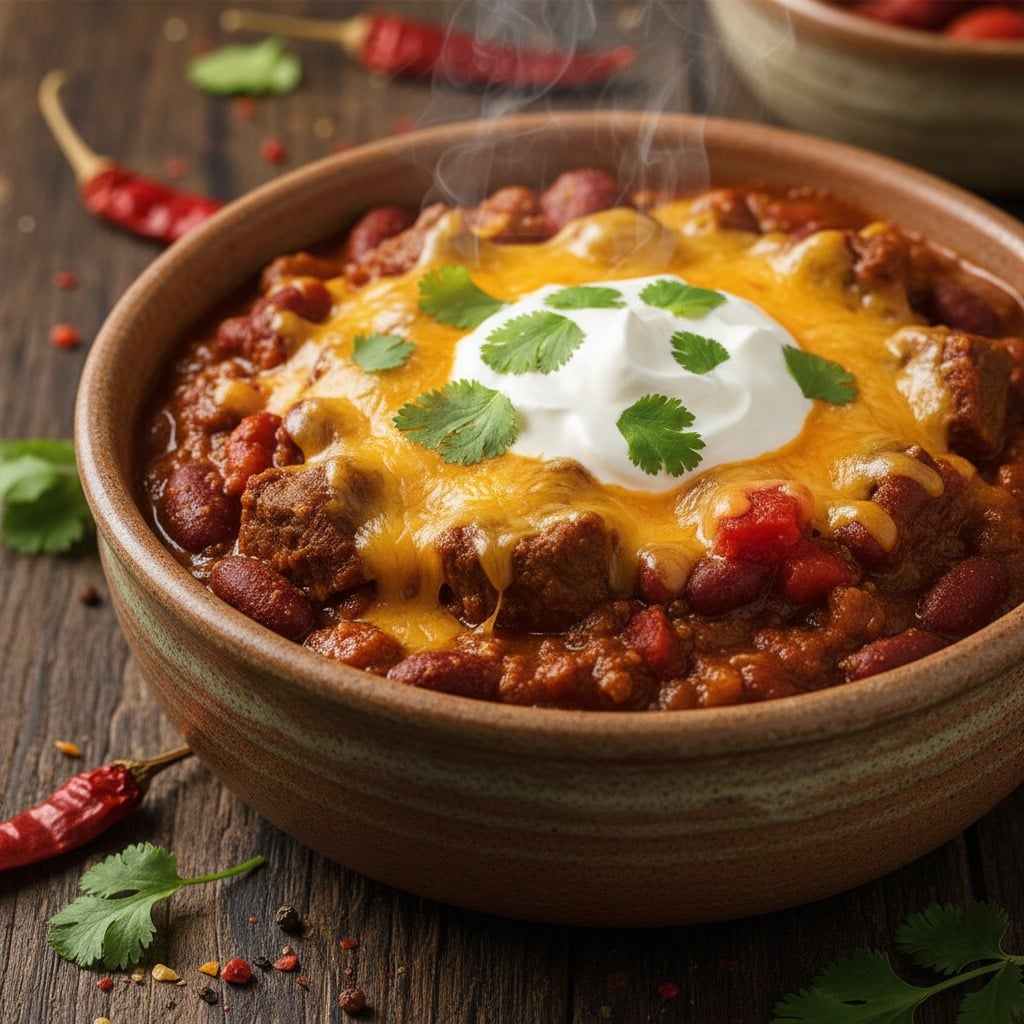
Classic Beef Chili Con Carne
Classic Beef Chili Con Carne Overview Ingredients Instructions Cultural History The Origins and Evolution of…

Leave a Reply